B2B pricing strategy: how to develop your optimal pricing strategy?
Mondrio Team · Aug 20, 2026 · 6 min read
What is the optimal pricing strategy for a B2B tech company?
The optimal B2B pricing strategy aligns three things: the value your solution delivers to each customer segment, the way customers prefer to pay, and a model that can evolve as both change.
In practice, this means getting five things right:
- Segmenting by needs, not only demographics. Customers in the same vertical often have wildly different willingness to pay based on how they use your solution. Needs-based segmentation is more precise and more profitable.
- Aligning packages with your segments' solution needs. Each tier in your pricing should serve a distinct customer segment with a clearly different set of needs. An SMB and a large enterprise on the same package is a red flag: it means your packaging isn't reflecting real differences in how they use and value your product.
- Choosing a price metric that scales with value. How you charge matters more than what you charge. A per-user model caps your upside if value grows with usage. A usage- or outcome-based model grows with the customer.
- Setting prices at the right level and protecting them. Your price should reflect what customers are actually willing to pay, validated through structured research. But knowing the right price is only half the battle: consistent discount governance ensures you don't give it away in deals.
- Building in a regular review cadence. Pricing should be reviewed continuously, not just annually, to catch changes in competitive positioning, product value, and customer expectations before they cost you revenue.
How to implement value-based pricing in B2B
Value-based pricing means setting prices based on the value your solution delivers to customers, not on your costs or what competitors charge. Here's how to do it, step by step.
Step 1: Start with segmentation
Before you can price effectively, you need to understand who you are pricing for. Analyze your existing customer base:
- Who are your highest-value customers? Look at ARR, NPS, expansion rate, and product usage patterns.
- What do they have in common? Think beyond firmographics: industry and size are useful, but use case and buying behaviour matter more.
- How do their needs differ? Check usage data. A power user who relies on your solution daily has a fundamentally different willingness to pay than someone who logs in occasionally.
From this, define 2-4 distinct customer segments based on needs and value drivers. A 50-person fintech and a 50-person retailer may look identical on a spreadsheet but have completely different pricing tolerance and solution requirements.
Step 2: Design packaging that serves each segment
Once you understand your segments, build a packaging around them. There are four main packaging structures, and the right one depends on how different your segments' solution needs are:
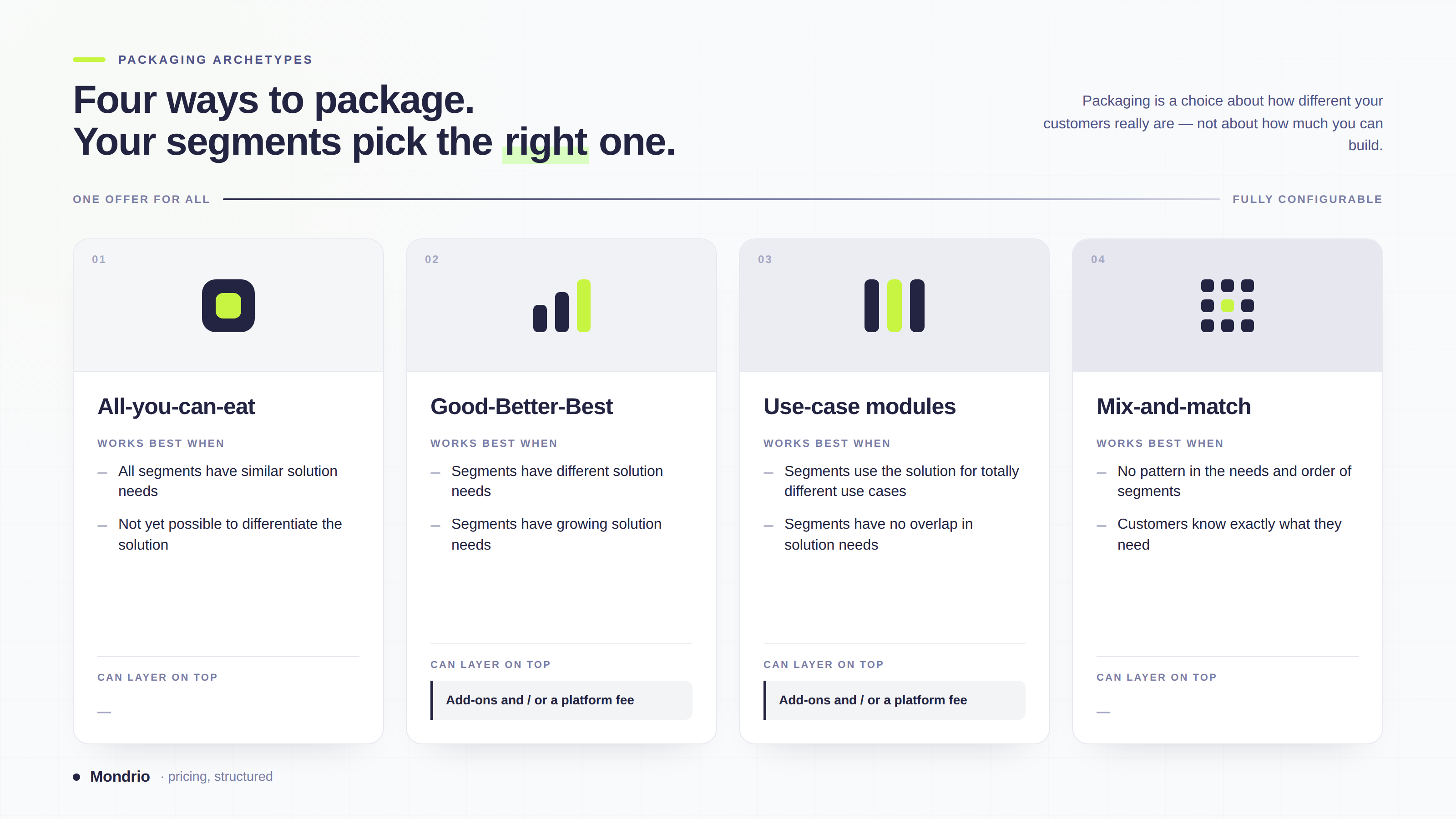
The most widely used structure in B2B Tech is Good-Better-Best. It works when segments have genuinely different solution needs and growing complexity. When allocating features to tiers, use the Leader/Filler/Killer framework:
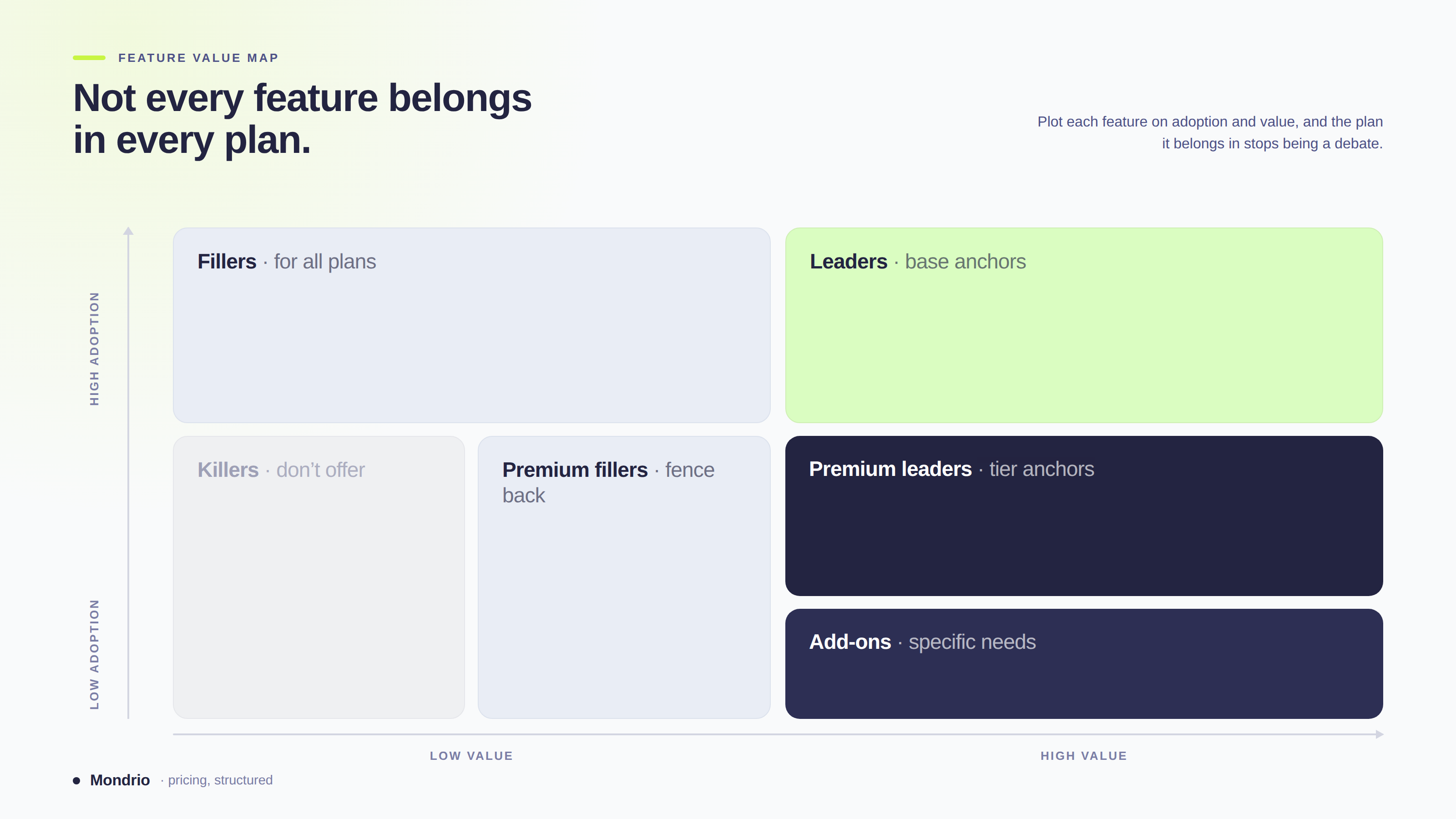
- Leaders: Core differentiating features that drive purchases and upgrades. Put your best leaders in the base plan to attract buyers, and your premium leaders in higher tiers to drive upgrades.
- Fillers: Widely used but not decisive. Include across all plans.
- Killers: Features that might deter buyers or create confusion. Don't lead with them or communicate them prominently.
- Add-ons: High-value features needed by only a subset of customers. Price separately rather than including for everyone.
Practical tip: if fewer than 10% of customers buy a higher tier, the upgrade proposition is too weak. Revisit which premium leaders are behind the paywall.
Step 3: Pick a price metric that grows with your customer
The price metric is what appears on the invoice. It's one of the most strategic decisions in pricing. The best metric:
- Scales with the value the customer receives
- Is measurable and predictable, with no disputes on the invoice
- Is understandable for the buyer in 30 seconds and feels fair to them
- Is future-proof when your solution grows
Common B2B Tech metrics and when to use them:
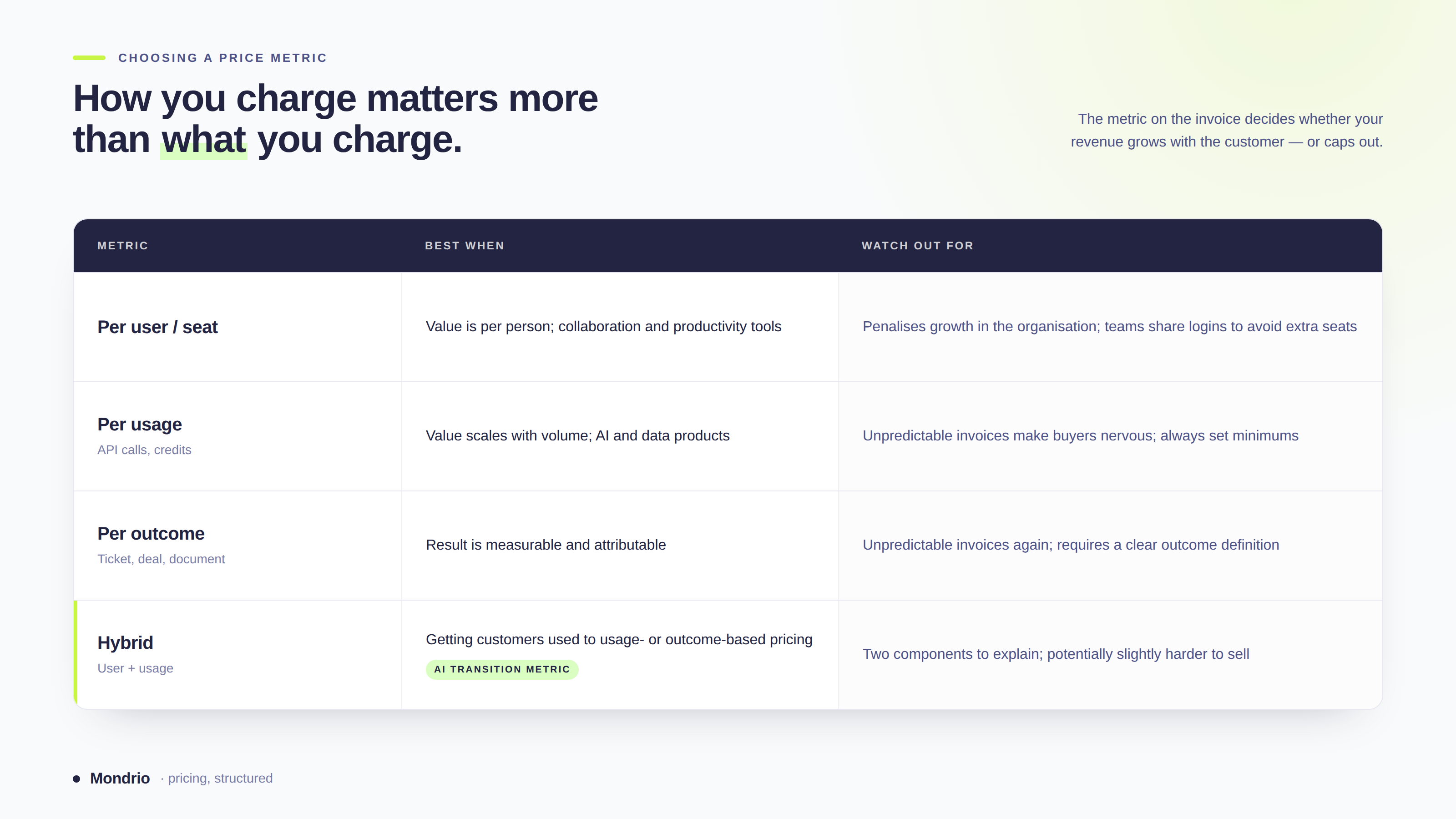
| Metric | Best when | Watch out for | | -------------------------------------- | ------------------------------------------------------------------------------ | ------------------------------------------------------------------------------- | | Per user/seat | Value is per person; collaboration and productivity tools | Penalises growth in the organisation; teams share logins to avoid extra seats | | Per usage (API calls, credits) | Value scales with volume; AI and data products | Unpredictable invoices make buyers nervous; always set minimums | | Per outcome (ticket, deal, document) | Result is measurable and attributable | Unpredictable invoices again; requires a clear outcome definition | | Hybrid (user + usage) | AI transition metric, to get customers used to usage-/ outcome-based pricing | Two components to explain; potentially slightly harder to sell |
Step 4: Validate your price level through customer research
Never set prices in a boardroom. Use these two validated research methods to find what customers are actually willing to pay:
Van Westendorp Price Sensitivity Meter: Ask four questions per segment: at what price is this too cheap (quality concern)? Cheap but a bargain? Expensive but still worth it? Too expensive? The overlap of responses defines an acceptable price range per segment. Run this on 50-150 respondents per segment.
Gabor-Granger: Present specific price points and ask "Would you buy at €X?" across subgroups. This builds a demand curve that shows the revenue-maximising price, not just the acceptable range.
These methods regularly reveal that customers in your highest segments would pay significantly more. They also expose which features you're charging a premium for that are already seen as table stakes, and which ones have untapped pricing potential.
Step 5: Set up conditional discounting
The most overlooked part of value-based pricing is protecting the prices you've set. Every unchecked discount is a direct margin cut. Best practices:
- Always ask for something in return: a longer commitment, a case study, faster payment, or a reference call.
- Define a maximum discount per role. For example: an AE can approve up to 10%, a manager up to 20%, and anything above requires VP or CFO sign-off.
- Set absolute floor prices per tier that cannot be crossed under any circumstances.
- Track discounts quarterly. If your average discount exceeds 35%, you have a discipline problem, not a pricing problem.
Pricing is not a one-time exercise. The most effective B2B companies treat it as a continuous discipline: monitoring, experimenting, and adjusting as their solution evolves and market signals change. Set a quarterly review cadence. Revisit pricing every time you ship a major feature, enter a new market, or see a competitor change their model.